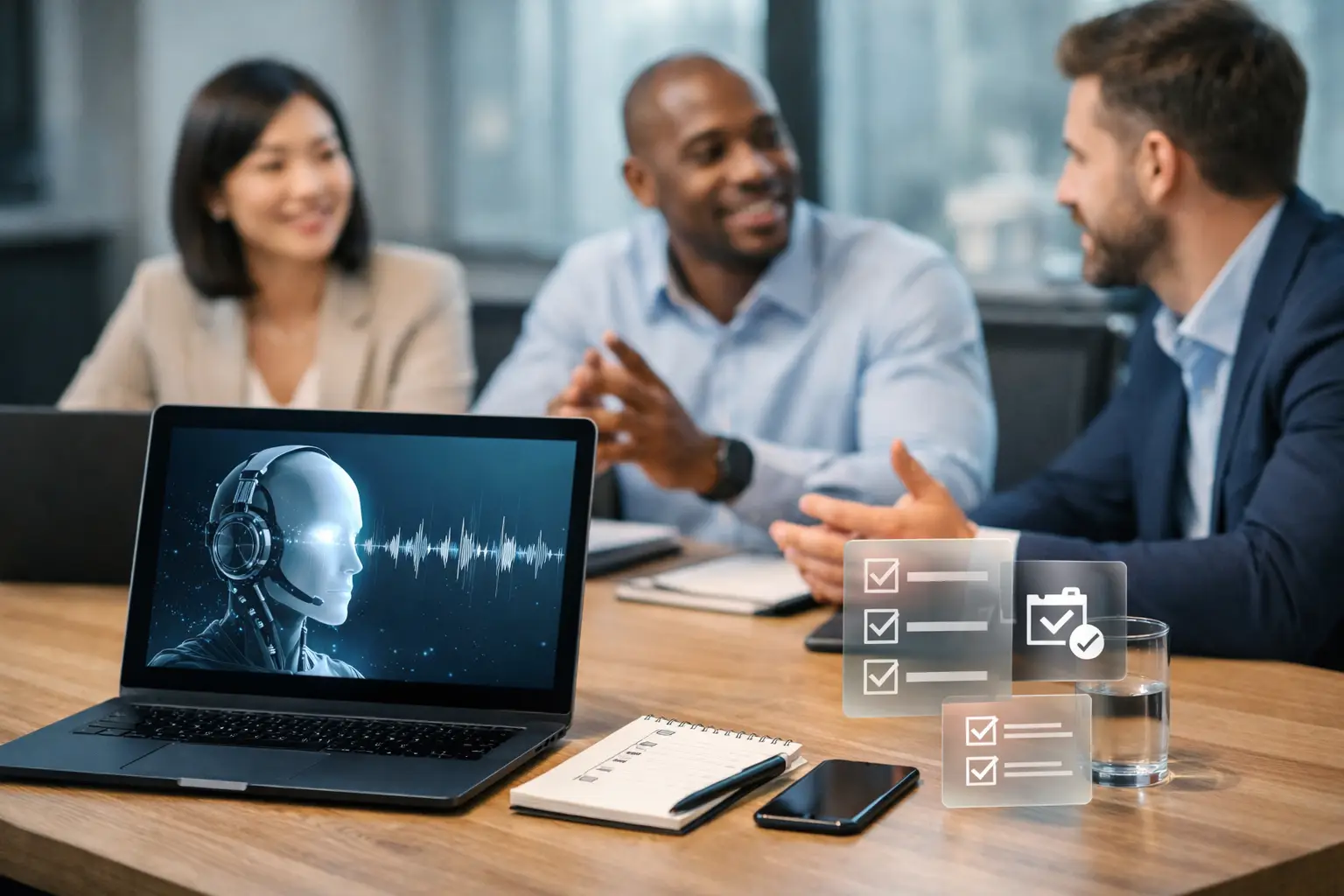
AI Meeting Transcription With Action Items
A meeting is not productive because everyone talked. It is productive when the decision survives the call, the right person owns the next move, and the work actually begins. AI meeting transcription with action items closes the gap between conversation and execution by turning live discussion into a structured operational record.
For fast-moving product, engineering, marketing, and leadership teams, that record cannot be a wall of text dropped into another disconnected tool. It needs to preserve the why behind a decision, identify the owner, connect to the project context, and give the team a clear path from discussion to delivery.
Why Transcripts Alone Do Not Move Work Forward
Automatic task allocation to the folder Kanban
Most meeting transcription tools solve only the first layer of the problem: recording what was said. That is useful for recall, compliance, and people who could not attend. But a transcript is still raw material. Someone must review it, decide which statements count as commitments, assign ownership, create tasks, and share the result with the people who need it.
That manual cleanup is where momentum disappears. A product manager leaves a roadmap review with six implied follow-ups. An engineer agrees to investigate a production issue. Marketing commits to revising launch positioning. By the time the notes are polished, priorities have shifted and the details have faded.
The better standard is not “Was the meeting transcribed?” It is “Can the team act on what the meeting decided?” AI should recognize decisions, requests, risks, deadlines, and unresolved questions while the conversation is still fresh. Then it should place those outputs where the work already lives.
What AI Meeting Transcription With Action Items Should Capture
A useful system does more than label every sentence spoken by a participant. It creates an accountable view of the meeting without stripping out the nuance that made the decision valid.
Decisions and the reasoning behind them
A decision without context becomes a recurring argument. If a team agrees to delay a feature, the record should capture not just the decision but the constraint behind it: customer risk, engineering capacity, legal review, or a dependency that is not ready.
This matters when new teammates join, when leadership asks why a date changed, or when a decision needs to be revisited. The transcript provides evidence. The AI-generated summary provides the operational version of that evidence.
Action items with real owners
“Follow up with the customer” is not an action item if no one owns it. Strong action extraction identifies the task, the accountable person, the expected outcome, and the date or trigger that makes it due.
It should also distinguish between an explicit commitment and a casual suggestion. “I can look into it” may be exploratory. “I will send the revised proposal by Thursday” is a commitment. AI can make this distinction more reliably when it has access to the project, the participant roles, and the conversation history around the call.
Open questions, risks, and dependencies
Not every meeting ends with a clean answer. Sometimes the most valuable outcome is a clear list of what remains unknown. A well-designed meeting output separates decisions from open questions so teams do not mistake uncertainty for approval.
For example, a release meeting may approve the launch plan while leaving security review as a blocking dependency. If that dependency is buried on page eight of a transcript, it will be missed. If it is surfaced as a risk with an owner, it can be managed.
The Workflow That Turns Calls Into Execution
VB Kanban - the development board with coding agents
The strongest workflow begins before the meeting. The AI needs enough context to understand what the call is about, who is responsible for which area, and what deliverables are under discussion. A generic transcription tool hears words. A connected work system understands that “the migration” refers to a specific project and that “the draft” belongs to a current launch plan.
During the call, accurate speaker attribution matters. Teams need to know whether a commitment came from the engineering lead, the customer success manager, or an external stakeholder. For customer calls and cross-functional reviews, this is also where consent, recording policies, and clear participant notification matter. AI does not remove the need for responsible meeting practices.
After the call, the system should create a concise meeting brief: decisions, action items, owners, due dates, risks, and open questions. The full transcript remains available for verification, but the brief becomes the artifact people use. A team member should be able to scan it in under two minutes and know what changed.
The final step is the one many tools leave to the user: execution. Action items need to enter the team’s project flow, connect to files and prior discussions, and remain visible until completed. If every meeting creates a separate note with no relationship to the workboard, chat, project folder, or engineering backlog, the team has simply created another place to forget things.
From Decision to Delegated Execution
This is where AiMixUp closes the loop instead of stopping at a summary. When a call ends, the extracted action items do not sit in a document waiting for someone to re-enter them by hand. They are created automatically as tasks on the project’s Folder Kanban, the board that lives inside the relevant Smart Folder, already carrying the call’s context, files, and decision history. The decision, its owner, and its due date land on the board where that work already belongs.
From there, a task can be delegated immediately for execution on the VB Kanban, where AI teammates pick it up and start doing the work. What happens next depends on the flow each team has configured. Some tasks move straight into autonomous execution the moment they arrive. Others wait in a review or backlog column until a human confirms scope or approves the plan before an AI teammate begins. The board adapts to how much control a team wants to keep, rather than forcing one rigid path.
The result is a continuous line from conversation to delivery. A commitment made on a call becomes a tracked, owned task on the right board within seconds of the meeting ending. It is planned on the Folder Kanban and executed on the VB Kanban, with no manual copy-paste, no separate tool, and no follow-ups quietly lost between them.
Where Teams Gain the Most Time
The value is not limited to saving someone from typing notes. It comes from reducing coordination drag across recurring workflows.
A product team can turn customer discovery calls into a searchable evidence base, with feature requests, objections, and follow-up commitments tied to the product area being discussed. Instead of relying on one person’s interpretation, the team can review the source conversation and compare patterns across calls.
Engineering leaders can use incident reviews and sprint planning sessions to capture technical decisions, owners, and blockers without asking an engineer to spend another hour translating a call into tickets. The transcript is especially valuable when the discussion includes trade-offs that will matter during implementation.
Sales and customer success teams can preserve commitments made in account reviews. A rep should not have to reconstruct a renewal conversation from memory, and a handoff should not depend on private notes. The next owner needs the customer’s priorities, promised deliverables, and unresolved concerns in context.
Executive teams benefit differently. Their meetings often produce high-level decisions that affect multiple functions. Clear action extraction prevents a leadership decision from splintering into five inconsistent interpretations after the call.
Accuracy Matters, but Context Matters More
No transcription system is perfect. Industry terms, overlapping voices, weak audio, accents, and fast-paced debate can affect accuracy. Teams should treat AI outputs as high-speed drafts with an audit trail, not as unquestionable records.
For high-stakes meetings, review controls are non-negotiable. The meeting owner should be able to correct a speaker, edit a deadline, reject a false action item, and confirm sensitive decisions before they are distributed. This is particularly important in regulated environments, personnel conversations, legal matters, and enterprise customer negotiations.
Context also determines whether an extracted action item is useful. “Update the deck” is vague. “Revise the enterprise security slide using the approved RBAC and audit-log language before Friday’s procurement review” is executable. The difference comes from connecting the call to documents, project knowledge, and the team’s existing work.
What to Look for in a Team-Ready System
When evaluating AI meeting capabilities, look beyond the demo where a clean call becomes a polished summary. Real work is messier. People change their minds, meetings reference old files, decisions span departments, and sensitive data cannot be sent anywhere without controls.
A team-ready platform should provide accurate transcription, speaker-aware summaries, editable action items, and persistent context across calls, chats, files, and projects. It should also support governance appropriate to the organization, including permissions, auditability, retention control, and private deployment options when required.
Model choice matters too. Different AI models can be better at summarization, reasoning over technical discussion, or extracting structured tasks. Teams should not have to rebuild their workflow every time they want to compare output quality. A workspace that brings humans and multiple AI models into the same operating layer gives teams more control over how meeting intelligence is produced and reviewed.
AiMixUp is built around that operating model: calls, shared context, Smart Folders, project coordination, and AI teammates in one workspace. The goal is not another standalone meeting bot. It is a disciplined system where a conversation becomes a tracked decision, a task planned on the Folder Kanban, and, when the team is ready, work delegated to the VB Kanban for execution, all without losing the context that made it matter.
Make the Next Meeting Accountable
Start with one recurring meeting where missed follow-ups are expensive: sprint planning, customer reviews, launch coordination, or leadership staff meetings. Define what counts as a decision, what information every action item must include, and who validates the output after the call.
Then measure the result in operational terms. Are fewer commitments getting lost? Are handoffs faster? Can someone who missed the meeting understand the decision without scheduling another one? The real payoff from AI meeting transcription is not cleaner notes. It is a team that leaves the call already moving.
Related Articles
Enjoyed this? Try AiMixup with free credits
Drop your email, create your account, and we'll load bonus AI credits into it so you can try everything.