
What an AI Team Chat Platform Should Do
Most teams do not have an AI problem. They have a coordination problem wearing an AI badge.
A few people use one chatbot for drafting. Someone else runs meeting transcripts through another tool. Product keeps research in one app, engineering keeps specs in another, and marketing copies outputs into chat threads that disappear by Friday. That is why the real question is not whether you need AI. It is whether you need an ai team chat platform that can turn scattered prompts into shared execution.
That distinction matters. A consumer chatbot helps one person think faster. A team platform changes how work moves across functions, decisions, files, and deadlines. If your goal is real output, not isolated experiments, the bar is much higher.
Why an ai team workspace platform is different from a chatbot
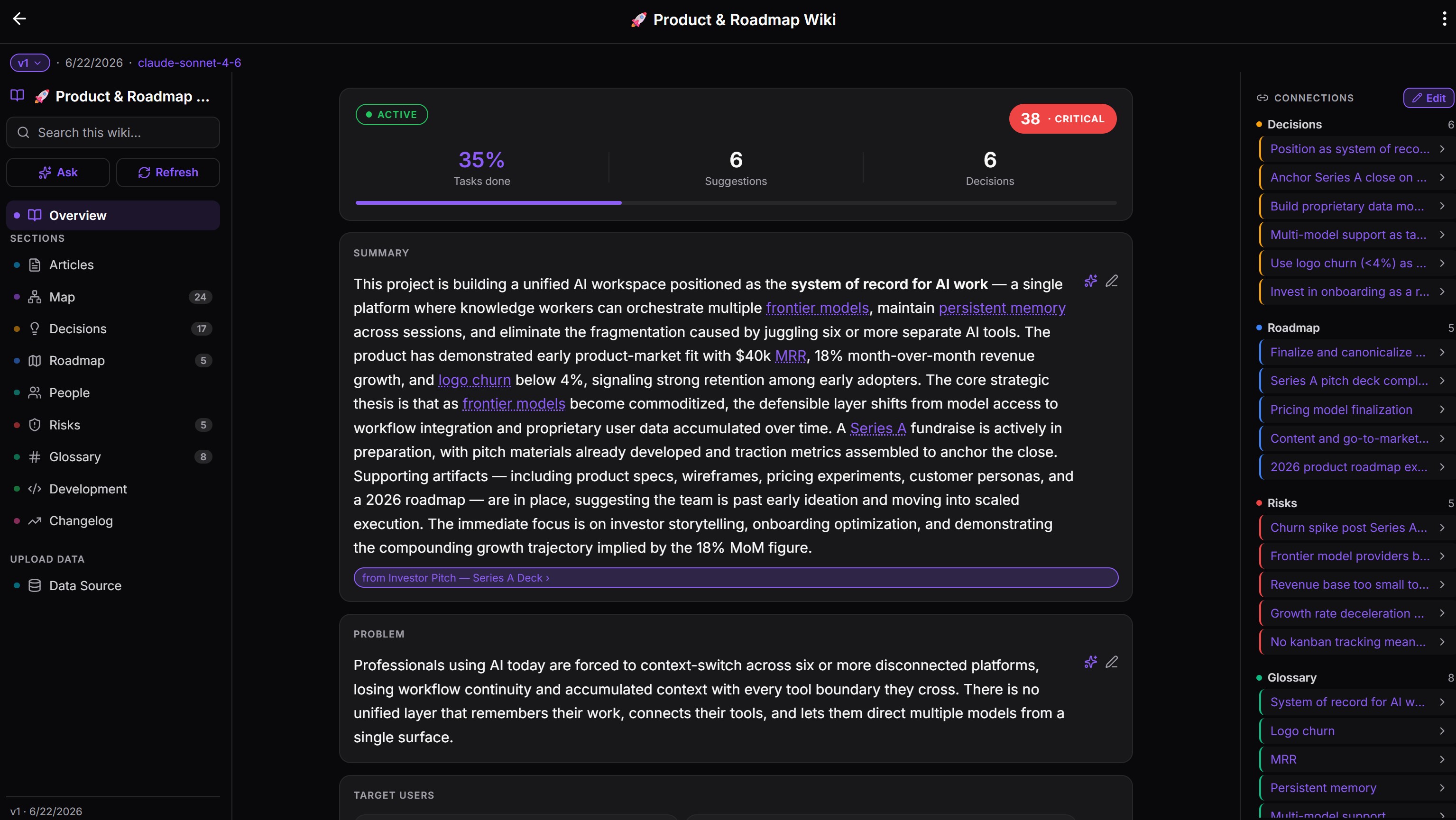
Project Wiki - preserve context across the entire project including development
A standard chatbot is built for single-user interaction. You ask, it answers, and the value mostly lives in that moment. That works for quick tasks, but it breaks down when work becomes collaborative, recurring, and tied to business context.
An ai team workspace platform has to carry context across people and projects. It needs to know that the sales deck, the customer call transcript, the feature spec, and the launch brief are part of the same operating reality. It also has to support review, handoff, and accountability. If AI is only producing text in a private window, your team is still doing the hard part manually.
This is where many companies lose time. They think they are adopting AI, but what they are really adopting is more fragmentation. The result is familiar: duplicate work, weak version control, model confusion, and zero confidence that the final answer reflects the latest information.
The standard is execution, not conversation
The best test for any ai team workspace platform is simple: does it help your team finish work faster with more control?
That means chat cannot be the destination. It has to be the interface for action. Teams need to move from a message to a decision, from a decision to a task, from a task to a deliverable, and from a deliverable to a documented record. If the platform cannot support that chain, it becomes another place where ideas go to stall.
Execution-focused teams should expect a lot more than conversational polish. They should expect shared workspaces, persistent project memory, file analysis, meeting intelligence, web research, and workflows that connect AI output to actual operations. In technical organizations, the standard rises further. AI should help move code, specs, QA, and release work forward without forcing teams to abandon governance.
That is the gap between AI that demos well and AI that survives contact with a real business.
What high-performing teams actually need
First, they need shared context. The problem with most AI usage is not output quality alone. It is context decay. Every new prompt starts from partial information, and every teammate brings a different fragment of the story. A serious platform preserves project knowledge so the team is not constantly rebuilding the same briefing.
Second, they need model choice. Different models are good at different things. One may be stronger at synthesis, another at coding, another at long-context analysis. Teams that rely on a single model often mistake convenience for strategy. Side-by-side comparison is not a luxury feature. It is a trust feature, especially when decisions carry product, legal, or financial impact.
Third, they need AI to work where the work already lives. Calls, documents, task planning, technical specs, image generation, research, and code delivery should not require a chain of disconnected tools. Every handoff creates latency. Every copy-paste creates risk.
Fourth, they need control. That means permissions, auditability, workspace structure, and deployment options that fit the business. For startups, speed matters. For enterprise teams, speed without governance creates a different kind of drag. The right platform has to do both.
The hidden cost of fragmented AI stacks
A fragmented stack looks manageable at first because each tool solves a narrow problem. One app transcribes calls. Another summarizes PDFs. Another writes content. Another handles image generation. But once teams start depending on these tools together, the operational tax shows up.
People stop trusting where the latest version lives. AI outputs become hard to trace back to source material. Team members rerun the same tasks because prior context is locked in personal accounts or lost in long chat threads. Managers cannot tell whether AI is accelerating the system or simply adding another layer of software overhead.
This is why consolidation matters. Not because fewer tools always means better outcomes, but because AI depends heavily on context continuity. When research, discussion, and execution happen in separate environments, quality drops and rework climbs.
A unified workspace changes that dynamic. It lets teams reuse context, compare outputs, attach files and decisions to the same thread of work, and create a clearer path from inquiry to delivery. That is how AI becomes operational infrastructure instead of sidecar software.
How to evaluate an AI team workspace platform
Start with the workflow, not the feature list. Ask where your team loses time today. Is it meeting follow-up? Spec creation? Research synthesis? Cross-functional handoff? AI should reduce those delays in a visible way.
Then look at how the platform handles shared memory. Can teams organize discussions, files, and AI outputs around projects instead of isolated chats? Can new contributors get up to speed without asking three people to forward background materials? If not, the platform may help individuals while slowing the team.
Next, test model flexibility. If the system locks you into one provider, you are accepting its strengths and weaknesses everywhere. That may be fine for a narrow use case, but it is limiting for broad team adoption. Serious organizations want options because they want leverage, resilience, and better task fit.
After that, examine execution depth. Can the platform analyze files, support calls, manage research, generate creative assets, and assist technical workflows in one environment? Or does it send your team back out to specialized tools every time work gets real? There is no universal right answer here. Some teams need a focused layer. Others need an operating system.
Finally, evaluate security and governance early, not late. It is easy to ignore SSO, role-based access, audit logs, or private deployment when testing with a small group. It is much harder to retrofit trust once adoption spreads. The right choice depends on company size, data sensitivity, and compliance pressure, but the requirement for control usually arrives sooner than expected.
Where this gets especially valuable
Product teams benefit because specs, customer feedback, call notes, and prioritization discussions can live in the same workspace as AI analysis. That shortens the distance between signal and roadmap.
Marketing teams benefit because campaign planning, content production, research, creative iteration, and asset generation stop bouncing across disconnected apps. Speed improves, but more importantly, context stays intact.
Engineering teams benefit when AI moves beyond code suggestions and into coordinated delivery. Shared project memory, technical discussion, coding assistance, and structured development workflows make AI more useful because they reduce ambiguity, not just keystrokes.
Enterprise operators benefit because centralization creates visibility. When AI usage is spread across shadow tools, no one has a clear picture of process, risk, or ROI. A consolidated platform makes adoption measurable and governable.
This is also where platforms built for real work stand apart. An example is AiMixUp, which positions AI inside the operating layer of teamwork rather than as a standalone assistant. That approach matters because companies are not looking for one more smart window. They are looking for a system where humans and multiple AI models can work against the same context with speed and control.
The trade-off leaders should think about
An all-in-one platform is not automatically the answer for every company. If your team has one narrow AI use case and little need for collaboration, a simple tool may be enough. If your workflows are complex, cross-functional, and high-volume, point solutions usually hit a ceiling fast.
There is also a change-management factor. A powerful platform can centralize work, but teams still need norms for how to use it. Who owns shared context? Which model is preferred for what kind of task? When should AI outputs be reviewed by humans? Better software helps, but operating discipline is what turns speed into repeatability.
That is the real opportunity. The category should not be judged by how cleverly AI chats. It should be judged by whether your team can think, decide, and ship in one controlled environment.
If you are evaluating the next phase of AI adoption, raise the standard. Choose a system that treats AI like a teammate inside the workflow, not a detached assistant on the side. That is how faster work starts compounding into better operations.
Related Articles
Enjoyed this? Try AiMixup with free credits
Drop your email, create your account, and we'll load bonus AI credits into it so you can try everything.